
Before You Search for Another “InBody Scan Near Me,” See This At-Home Alternative
By Lena Hartwell · Updated April 2026 · 6 min read
"I was driving 35 minutes each way to get my body composition tested. Then I found out I could run the same scan in my bathroom, at the same time, every morning."

The Problem with Booking Another InBody Scan
If you've ever booked an InBody appointment, you know the routine.

Skip your morning workout.
Don't drink coffee.
Don't eat for at least three hours.
Don't exercise for one to three days before.
Hold still. Stand barefoot.
Pay $40 to $80. Get a printout. Drive home.
And then? You wait for a few days and do it all over again, because that's the only way to know if anything has changed.
InBody's own instructions guide tell you to test at the same time of day every time, after a 1–3 day rest from exercise, with normal hydration, an empty stomach, and stable body temperature.
BIA technology genuinely needs those conditions to give a clean reading. But it does mean one thing for the rest of us:
You can't track your body. You can only sample it occasionally.

The Same Technology But More Convenient Address.
Here's what most people searching "InBody scan near me" don't know: InBody and the Hume Pod use the same technology: Bioelectrical Impedance Analysis, or BIA.
Both send a small, harmless current through your body. Both measure how your tissues resist that current.
Lean tissue has more water and conducts well; fat tissue resists. Both run those readings through prediction equations to estimate fat mass, lean mass, and total body water.
What's different is the form factor. InBody is a clinic machine you visit.
Hume is the same category of tool, sitting in your bathroom.
Same method, three key parallels:
Multi-frequency BIA. Both InBody and Hume use multiple frequencies, low frequencies pass through extracellular water, high frequencies pass through both extracellular and intracellular water. This is what separates fluid compartments and lets the device estimate ICW vs. ECW.
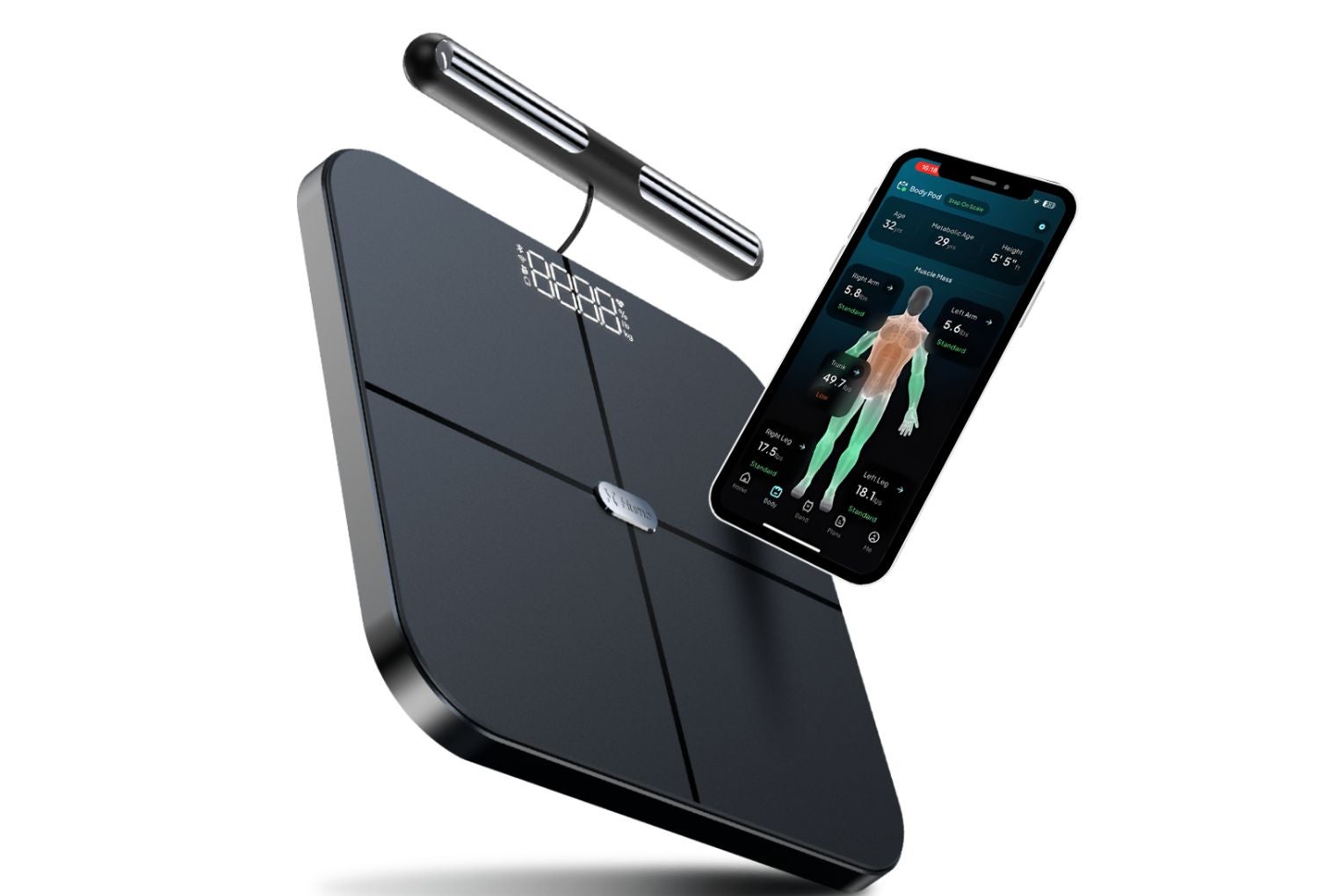
Hume's eight-electrode design uses four hand contacts and four foot contacts, right arm, left arm, trunk, right leg, and left leg as separate cylinders. That's how you get limb-by-limb readings instead of a single whole-body number.

Why Trend Beats Generic Snapshots
One InBody reading, on its own, tells you very little.
BIA is sensitive: to hydration, to the time of day, to whether you ate, to whether you trained, to room temperature.
Hume says: "every measurement is an estimate derived from a physical signal via a model, not a direct chemical or cellular assay."
What that means is simple: a single scan is noise. A pattern across scans is a signal.
If you scan once a quarter at the clinic, you're seeing four data points a year and each one is filtered through whatever you ate, drank, slept, and trained the day before.
If you scan every morning at home, under the same conditions, you're watching a moving average. The noise cancels. The trend shows up.
What the Hume Pod Measures
Walking through the Hume Pod's official spec sheet feels less like reading a smart-scale brochure and more like reading a clinic intake form. It tracks 45 body composition metrics in total. The ones that matter day to day:

The metrics that drive your decisions
01. Body Fat %
Composition over weight. The difference between losing fat and losing muscle.
02. Visceral Fat
The fat around your organs, the kind that drives metabolic risk, not the kind you see.
03. Skeletal Muscle
Tracked separately from total muscle mass. Tells you if you're holding lean tissue while cutting.
04. ICW / ECW Balance
Intracellular vs. extracellular water. The same fluid compartment data clinics flag for inflammation and recovery.
05. Segmental Lean
Right arm, left arm, trunk, right leg, left leg. Each measured independently. Catches asymmetries.
06. Metabolic Age
Your basal metabolic rate compared against age norms. A rough read on your metabolic baseline.
Free Worldwide Shipping · 45-Day Returns
Hume Pod is DEXA-comparable. Verified and tested in a Socotech study that placed the Pod within ±2% of a DEXA scan, and other validation noting body fat readings within 0.2% of DEXA on certain measures.
Use it as a tracking instrument. Daily readings under consistent conditions give you a moving picture of where your body is heading.

Hume vs. InBody Visit
InBody Scan (Clinic)

Quarterly at best. Appointment required

Multi-frequency BIA · 8 electrodes · segmental
$40–$80 per scan · recurring fee
Printout per visit · no continuous trend
Standalone reading · no daily integration
HSA / FSA eligible (varies)
Hume Pod (At Home)
Scan every morning, same conditions
Multi-frequency BIA · 8 electrodes · segmental
One-time cost · own the device
45 metrics, weekly / monthly/yearly trends in app
Syncs with Apple Health, Fitbit, Garmin
HSA / FSA eligible (US)
The Hume Pod is here to replace the habit of driving across town for a measurement you should be able to take at home and to give you the daily data the clinic visits can't.
"I stopped guessing at month three."
Marcus K. had been doing quarterly InBody scans at a chain gym in Austin for two years. Down 18 pounds total. But his last two scans showed something he didn't expect: his body fat percentage barely moved, even though the scale did.
"The clinic guy told me I was probably losing muscle. Not fat. I had no way to confirm that, I'd just see him again in three months." After a friend mentioned the Hume Pod, Marcus started tracking every morning. Within four weeks, the trend was undeniable: his lean mass was dropping faster than his fat mass. He adjusted his protein intake and started lifting twice a week. Two months later, the lines had crossed.
"The number wasn't the point. The line was the point. I needed to see the line."
What Buyers Are Saying

"I was paying $60 a pop for InBody scans every six weeks. Bought the Hume Pod, did the math, it paid for itself in five months — and now I can see exactly when my visceral fat dipped after I cut alcohol. That's something I never would've caught on a quarterly cadence."
Priya R.
"What sold me was the segmental data. My right leg was reading 4% lower lean mass than my left for two months straight, turned out I'd been compensating after an old knee injury without realizing. My PT confirmed it. I would not have caught that with a once-a-quarter scan."
David W.
"I'm 47. Perimenopause started, and my body composition shifted hard. None of it showed up on a regular scale. The Hume Pod actually showed me where the fat was going (visceral, not subcutaneous) and that my muscle was holding. That's the kind of data my doctor wanted but couldn't give me without sending me out for tests."
Allison T.
How to Get a Clean Reading at Home
The Hume Pod follows the same prep logic as any BIA device.
Scan first thing in the morning, after using the bathroom and before eating or drinking. Stand on a flat, hard, uncarpeted surface. Bare feet. Hold the handles with both hands above waist level, thumbs on the sensors but not touching each other, elbows away from your sides. Stand upright, face forward, and wait until the app confirms the weigh-in is complete.
The Smarter Alternative to
InBody Scans

✔ Free worldwide shipping
✔ Dispatched same day on weekday orders
✔ 45-day return policy
✔ HSA/FSA eligible for US customers
✅ 10-Year Warranty ✅ 45-Day Returns
Customer Reviews

4.8 out of 5
48,252 Customer Reviews
Smart Full Body Scan
Real-Time App Sync
Multi-User Profiles
Interactive LED Display
Order Now and Receive a Special Discount!
That's the lowest bioelectrical impedance price that the Hume Health Pod has ever been offered for!
Compare that to:
● DEXA scans: $75-150 per session (you need 10+ sessions per year to track properly = $750-1,500/year)
● Bod Pod sessions: $50-75 per test
● Professional BIA analysis at clinics: $40-100 per session
● InBody scans at gyms: $25-50 per scan.
Check Availability
A note on accuracy: Bioelectrical impedance analysis produces estimates, not lab measurements. Readings are most useful when taken under consistent conditions and interpreted as trends over time. The Hume Pod is not a medical device and is not intended to diagnose, treat, or prevent any disease. For clinical questions, consult your healthcare provider.
© 2026 All Rights Reserved. Privacy Policy - Terms of Service