HUME POD vs. RENPHO: The Difference Between These Two Devices Is Not Price
A 3-year RENPHO user runs a DEXA scan, discovers a 4-point margin of error, and switches to the Hume Pod. This is a full breakdown of what actually changed.
By Jake Torres, 34 — Competitive Amateur Cyclist

I used the RENPHO for two years. I genuinely liked it. Then I switched to the Hume Pod and found out things about my body that two years of daily scale readings had completely missed.
Challenger
The Hume Pod
Full-body scanner
8-freq BIA
45+ metrics
The Standard
RENPHO Smart Scale
Bluetooth scale
Foot BIA
13 metrics
I race road bikes at the Cat 3 level. Watts per kilo is the number I live and die by. My training is structured, I use a power meter, I track everything. And for two years I weighed myself every single morning on a RENPHO scale because it was affordable, the app was clean, and it gave me numbers I could log and trend.
But 12 weeks on the Hume Pod showed me that I had been working with incomplete data for two years. Not because RENPHO is a bad product. Because of what foot-based BIA is physically capable of measuring and what it is not.
That distinction is the whole point of this review. So let me walk you through both devices properly.
The Ceiling of Foot-Only BIA
A foot-scale algorithm sees strong lower-body impedance, typical for anyone who trains legs regularly, and it projects health upward across the rest of your body. If your torso fat is higher than your leg fat, which is extremely common in trained athletes, the scale averages those realities into one number that hides what is actually happening.
You think you are leaner in your trunk than you are. You think your arms are more muscular than they are. Because the device never touched either of them.
For two years, this is exactly what was happening to me. My legs are well-developed from cycling. My RENPHO was seeing great lower-body readings and projecting a favorable whole-body composition. The true picture of what my torso and arms looked like never showed up once in my data.
"I was one of those guys who weighed himself every morning and thought he was being scientific. Turns out I was just watching one number while the actual story was happening in data I could not see.”
The Breaking Point
I Paid $300 for a DEXA Scan. What It Showed Me Was Hard to Look At
A DEXA scan, dual-energy X-ray absorptiometry, is the closest you can get to ground truth on body composition without an autopsy.
I did mine at a sports performance lab downtown after a cycling friend who runs a performance coaching business basically dared me to. He had done one and called it "humbling." I assumed I would come out looking pretty good. I was wrong.
+3.8%
Torso fat vs what my scale showed
My RENPHO had my overall body fat at 13.2%. DEXA showed my torso at 16.9%. Two completely different numbers for the most metabolically dangerous fat depot.
14%
Right leg muscle deficit vs left
DEXA confirmed what my power meter suspected. My right quad was 14% lighter than my left. Two years of training had not closed that gap because I could not see it.
Central
Fat distribution pattern
My fat was concentrated centrally, not peripherally. Exactly the pattern that raises cardiovascular risk and tanks watts per kilo. My scale had been averaging it away.
2 yrs
Duration I trained with incomplete data
Every training and nutrition decision I made for two seasons was built on a single inaccurate whole-body estimate.
I walked out and started looking for something that could give me that quality of regional body composition data without paying $300 every four weeks at a lab. That is when I found the Hume Pod.

The Hume Pod: What Is Different?
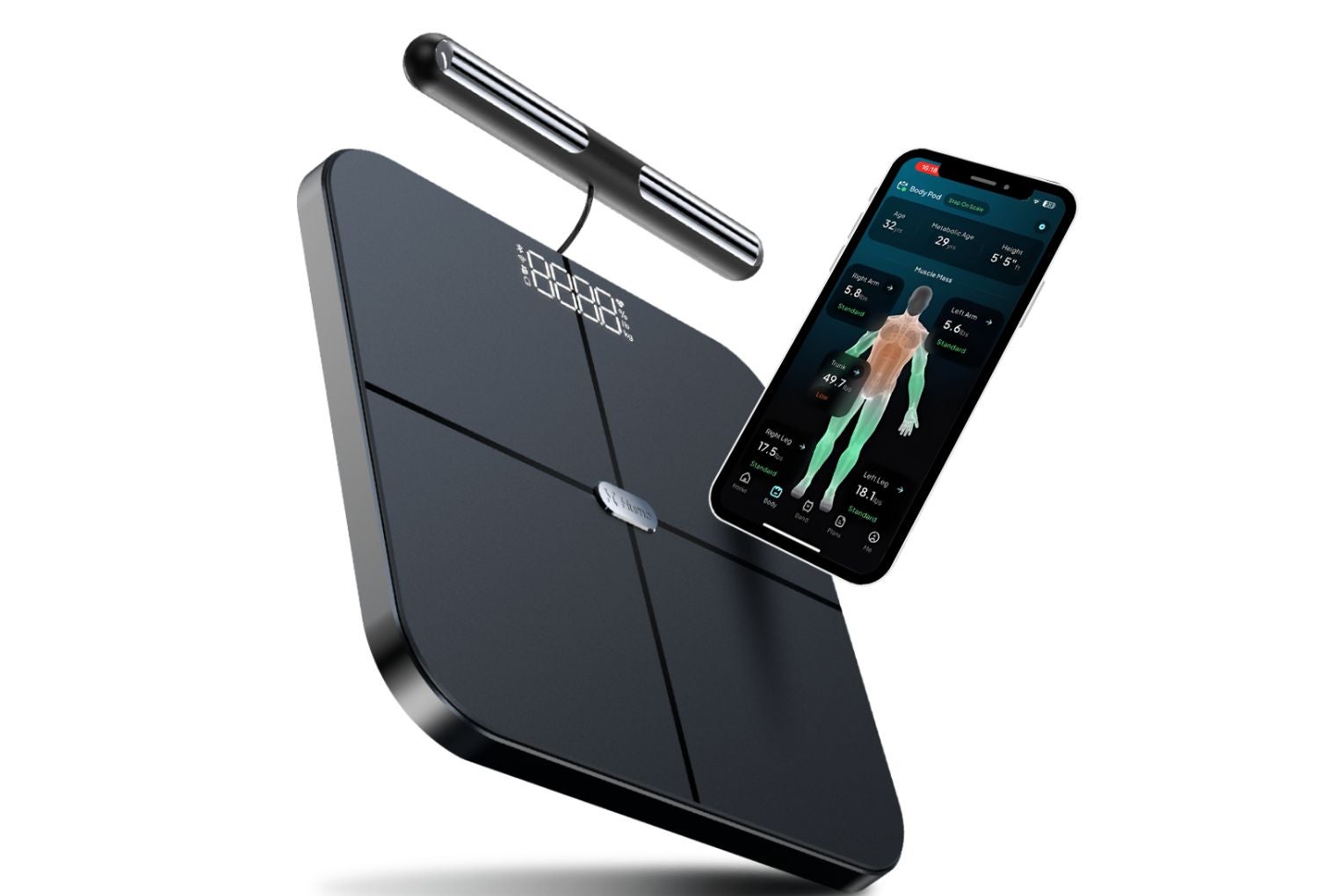
The first thing you notice about the Hume Pod is the handles. You grip them during the scan, and those grips are electrodes. Combined with the foot sensors, you have 8 contact points creating a full circuit through your entire body.
The current goes both directions. Your torso gets touched. Your arms get touched. The device is not estimating what is above your waist. It is measuring it.
BIA Contact Point: Why the Number Changes Everything
Basic scale
2 contact pts
Smart Scale
4 contact pts
The Hume Pod
8 contact pts
The second difference is frequency. The Hume Pod runs 8 electrical frequencies simultaneously. Different tissue types respond differently at different frequencies. Fat, muscle, and water all have distinct electrical signatures, and those signatures only show up clearly at specific frequencies.

Single-frequency BIA gets one data point. Eight frequencies gives you eight, each revealing something different about the tissue the signal is passing through.
For a cyclist trying to understand whether today's fatigue is true overtraining or just normal adaptation, that distinction is genuinely decision-changing.
My first scan on the Hume Pod showed my right leg was running a meaningful muscle deficit against my left. I had suspected this from my Assioma power meter data, which showed a 54/46 left-right split on long climbs. But I had no tissue data to confirm it.
Day one on the Hume Pod, sitting right there in the app. Once I had that number, I could program for it. Eight weeks later, the gap was closing in the data and my power split was moving toward 51/49. Two years on the RENPHO, that number was completely invisible to me.

Head to Head
RENPHO Gets Credit Where It Is Due. Hume Wins Where It Counts.
The Hume Pod: What It Wins
Torso and arm data: Directly measured, not estimated
Segmental breakdown: Left vs right, each independently
8-frequency BIA: Reads tissue RENPHO cannot see
ECW vs ICW: Recovery state in the morning data
45+ metrics: Visceral fat, bone density, CVD health score
Accuracy for athletes: Legs do not skew your whole read
RENPHO Smart Scale: What It Wins
Price: Best in class for what it costs
Setup: Five minutes, works immediately
App UX: Genuinely well-designed and intuitive
Weigh-in speed: Eight seconds, done
Household use: Multi-user, Baby Mode, family-friendly
General trend tracking: Useful over months
13 core metrics: Covers the main ones

The Call
Which One Is Right for You. Straight Answer.
I want to be straight here because this is a premium device and not everyone needs it. If you are just starting to track your weight and body composition, RENPHO is a completely rational starting point. Get the habit first. The daily check-in matters more than the precision when you are brand new to this.
But here is the list of people who need the Hume Pod specifically:
You train hard and your body fat number does not match how you look or perform
You have a left-right asymmetry in power output, running gait, or lift strength and you need tissue data to explain it
You want to know what your torso fat actually is, not what a foot-reading algorithm thinks it probably is
You have hit a performance or body composition plateau that more training and cleaner eating has not moved
You want a recovery-state read in the morning that tells you if yesterday's effort is actually clear
You have ever paid for a DEXA scan and want that quality of regional data at home, daily
The Honest Summary
RENPHO gives you weight plus a smart estimate of your body composition from your feet. It is accurate enough for general tracking and good enough for most people starting out.
The Hume Pod gives you your actual body composition, region by region, from a current that runs through all of it. For anyone who trains with specific goals, those are not interchangeable. One is a trend tracker. The other is a coaching tool.

| SPEC | HUME BODY POD | RENPHO SCALE |
|---|---|---|
| Electrode setup | 8-point hand + foot | Foot-only |
| BIA frequencies | 8 simultaneous | Standard single-path |
| Metrics per scan | 45+ | 13 |
| Torso measured directly | ✓ | ✕ |
| Left vs right legs | ✓ | ✕ |
| ECW / ICW split | ✓ | ✕ |
| Heart health metrics | ✓ | ✕ |
| Scan time | ~60 seconds | ~8 seconds |
| Price tier | Premium | $25–$40 |
| Best for | Athletes, performance, metabolic monitoring | Habit-building, general health, families |
Final Verdict
Three Months In, My W/Kg Is Moving for the First Time in Two Years
If you are serious about what you are building physically, whether that is cycling performance, body composition, metabolic health, or all of it at once, you deserve better data than a bathroom scale can give you. The Hume Pod gives you that data at home, in 60 seconds, every morning. That is genuinely new in the context of what has been available to non-clinical athletes until now.
45+ Metrics. 5 Segments. 60 Seconds.

Full-body BIA that reaches your torso and arms. Independent left-right readings. ECW/ICW recovery state. Heart health included. Every morning, at home.
Free basic app access included | Up to 24 users | ~60 second scan
Customer Reviews

4.8 out of 5
48,252 Customer Reviews
Smart Full Body Scan
Real-Time App Sync
Multi-User Profiles
Interactive LED Display

Order Now and Receive a Special Discount!
That's the lowest bioelectrical impedance price that the Hume Health Pod has ever been offered for!
Compare that to:
● DEXA scans: $75-150 per session (you need 10+ sessions per year to track properly = $750-1,500/year)
● Bod Pod sessions: $50-75 per test
● Professional BIA analysis at clinics: $40-100 per session
● InBody scans at gyms: $25-50 per scan.
Check Availability
The information and other content provided on this page, or in any linked materials, are not intended and should not be construed as medical advice, nor is the information a substitute for professional medical expertise or treatment.
If you or any other person has a medical concern, you should consult with your health care provider or seek other professional medical treatment. Never disregard professional medical advice or delay in seeking it because of something that you have read on this page or in any linked materials. If you think you may have a medical emergency, call your doctor or emergency services immediately.
© 2026 All Rights Reserved. Privacy Policy - Terms of Service